Trade show marketing for medical device companies: what the 2026 data says
Trade show marketing for medical device companies is the work of planning, staffing, and measuring a booth at a congress or exhibition so that conversations with clinicians, buyers, and distributors turn into qualified pipeline, using only approved content. It covers three phases: what you set up before the show, what happens at the booth, and how fast you follow up afterward. The 2026 data says most exhibitors lose the return in the third phase.
Trade show marketing is different from event management. Registration, floor plans, and badge systems belong to the show organizer. It is also different from a one-off product launch. A medical device company may exhibit at a dozen congresses a year, and the booth has to work the same way at each one, with the same approved claims.
Do trade shows still deserve the budget in 2026?
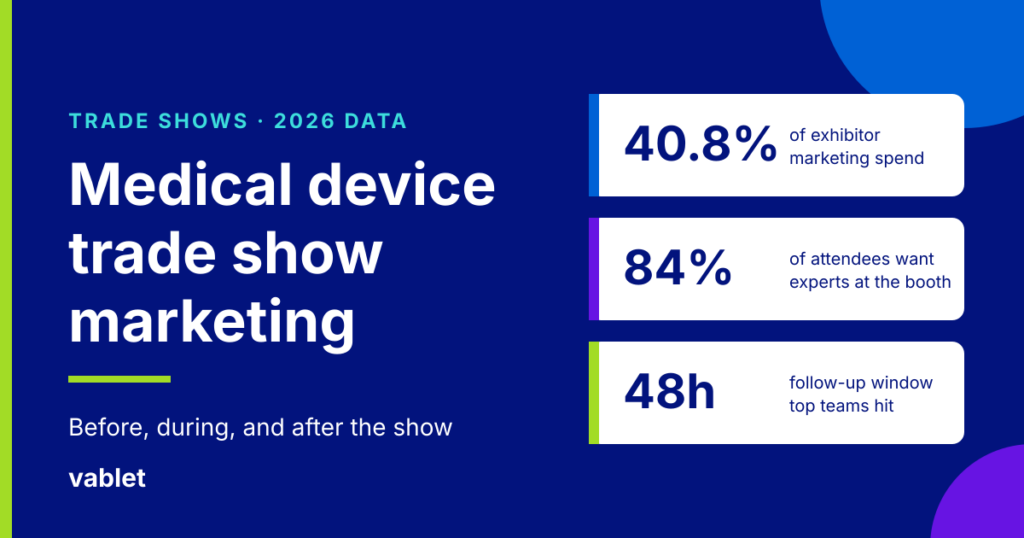
Yes, and exhibitors are voting with their budgets. In CEIR’s 2026 Marketing Spend Decision Report, exhibitions account for 40.8% of overall marketing spending among the exhibitors surveyed. In the same survey, 47% expect to exhibit at the same number of shows in 2026 and 28% expect to add shows. Forrester’s 2026 budget research found that nearly half of manufacturing and production respondents put more than 30% of their program budget into events.
The audience has mostly returned too. The CEIR Index peaked in the fourth quarter of 2025 at about 2% below its 2019 level, although attendance was still about 6% below 2019. IAEE forecasts that the index will grow 2.1% in 2026.
So the spend is large and stable. The harder question is whether anyone can show what it returned.
What the 2026 numbers say about booth performance
| Finding | Number | Source | What it means at the booth |
|---|---|---|---|
| Attendees who rate time with subject matter experts as extremely or very important | 84% | Freeman Commercial Trends Report, 2025 | Staff the booth with people who can answer clinical and technical questions |
| Exhibitors who agree that experts would improve booth interactions | 26% | Freeman, 2025 | Most booths are understaffed on expertise |
| Attendees more confident advocating for a product after touching or testing it | 96% | Freeman, 2025 | Plan a hands-on demo for every product you bring |
| Exhibitors who do not qualify leads at the booth | 51% | Spreadly Trade Show Pulse, June 2026 | Put three or four fixed questions in the capture form |
| Exhibitors whose first follow-up takes longer than 48 hours | 57% | Spreadly, June 2026 | Decide who follows up, and when, before the show opens |
| Event teams that cannot accurately attribute ROI to events | 86% | Vendelux B2B Events Survey, 2026 | Agree on the metrics before you book the space |
Two of these sources are small. The Spreadly report is based on 37 interviews and the Vendelux survey on about 120 event leaders. Read them as direction, and treat the larger Freeman study (1,022 attendees and 969 exhibitors) as the firmer benchmark.
Why a medical device booth is harder to run than other B2B booths
A software company can change its booth deck the night before. A medical device company cannot. Every claim on screen has been through medical, legal, and regulatory review, and the version shown has to be the approved one.
Four things make congress booths harder in this industry:
- The staff is mixed. Sales reps, clinical specialists, marketing, and distributor partners all present at the same booth, and each needs the same current files.
- The audience is international. A product cleared in one country may not be cleared in a visitor’s country, so the content shown has to match the market.
- Show-floor Wi-Fi is shared with thousands of other devices. A demo that needs a connection will fail at the worst moment.
- Lead capture is personal data collection. The AdvaMed Code update that took effect on November 1, 2025 added a section on data-driven technologies that calls for notice, permission, and collecting only the personal data you need.
If your field team already works in hospitals with restricted networks, you know this problem. The same discipline that covers offline sales enablement in an operating room covers a convention hall.
Before the show: decide what you will measure and what you will show
Pick the metrics first
Six numbers describe a show from first contact to revenue: meetings booked before the show, booth conversations, qualified leads, opportunities created, revenue closed, and return on the cost of exhibiting. Write the target for each before you sign the space contract. Vendelux found that 90% of event leaders see events influence deals that never get credit in the CRM. That gap starts when nobody agreed on the fields in advance.
Freeze the content
Build one booth collection of approved presentations, videos, IFUs, and clinical summaries, and set a cutoff date after which nothing changes without review. Remove expired versions from every device. A rep who opens last year’s deck from a personal folder creates the exposure your review process exists to prevent. Our guide to sales enablement for medical device companies covers version control and recall handling in more detail.
Book meetings before you travel
The visitors you most want have full agendas. Ask sales to book time with named accounts two to three weeks ahead, and give each meeting an owner and a goal.
At the booth: experts, hands-on demos, and qualification on the spot
Freeman’s research is blunt about what visitors want. They want to talk to someone who knows the product, and they want to handle it. Nearly one in four attendees said their most important event of the year had no hands-on exposure, and 42% of that group deprioritized the vendors involved.
For a device company, that means a clinical specialist is on the booth for every shift, and every product has a demo that works without a network. Put the supporting content (procedure video, clinical data, sizing guide) on a tablet next to the device so the specialist can answer the second and third question without leaving the visitor.
Qualify during the conversation. Use the same short form on every device, with the consent question first. Three or four fixed questions (role, facility, product interest, timing) are enough to sort leads the same evening. Free-text notes typed into a phone after the visitor leaves are how half of exhibitors end up with leads nobody can rank.
After the show: follow up within 48 hours
This is where the return is lost. In the Spreadly interviews, 57% of exhibitors took longer than 48 hours to send a first follow-up, and only 5% followed up the same day. Among the top-performing teams, 69% followed up within 48 hours. Among the weakest, 33% did.
Healthcare professionals expect it as well. The 2026 Emota and IPCAA congress report, based on 251 HCPs, lists timely and relevant follow-up after the congress among their main expectations.
Sort leads into three groups on the last evening of the show. Visitors who asked for a quote or an evaluation get a call from sales the next working day. Visitors who answered most qualification questions get the specific document they asked about and a meeting request. Everyone else gets the educational content that matches the product they looked at. In each case, send the approved file through a tracked channel so you can see whether it was opened.
A 10-point checklist for your next congress
- Write targets for meetings, conversations, qualified leads, opportunities, and revenue.
- Confirm which products and claims are cleared for the countries your visitors come from.
- Build one approved booth collection and set a content cutoff date.
- Load the collection on every booth device and test it in airplane mode.
- Schedule a clinical or technical expert for every booth shift.
- Prepare a hands-on demo for each product on display.
- Put the same capture form on every device, with consent and three or four qualification questions.
- Book meetings with named accounts before the show.
- Assign follow-up owners and a 48-hour deadline before the show opens.
- Report results against the targets within 30 days, and again when the sales cycle closes.
Where vablet fits
vablet is a sales enablement platform for medical device and life sciences field teams. At a trade show it covers the content side of the booth. Marketing publishes one approved collection, and it syncs to each rep’s iPad, iPhone, Android, or Windows device, where it presents without Wi-Fi. Capture forms work offline, sync when the device reconnects, and can publish to Salesforce, so booth leads reach the CRM without retyping. After the conversation, reps send approved PDFs with secureSend. vablet analytics show which files each rep presented and shared during the show.
vablet is not an event management platform. It does not handle registration, floor plans, appointment scheduling, or the organizer’s badge scanning, and it is not a CRM or a marketing automation tool. If your main gap is booking meetings or running nurture emails, buy a tool built for that. vablet is the right fit when the gap is approved content, offline demos, and a record of what each visitor was shown.
Frequently asked questions
What is trade show marketing for medical device companies?
Trade show marketing for medical device companies is the planning, staffing, and measurement of a booth at a congress or exhibition so that conversations with clinicians, buyers, and distributors become qualified pipeline. It includes pre-show meeting booking, approved booth content, hands-on product demos, lead capture with consent, and follow-up after the show.
How much of the marketing budget goes to trade shows in 2026?
In CEIR’s 2026 Marketing Spend Decision Report, exhibitions account for 40.8% of overall marketing spending among the exhibitors surveyed. Forrester’s 2026 budget research found that nearly half of manufacturing and production respondents allocate more than 30% of their program budget to events.
How quickly should you follow up with trade show leads?
Follow up with trade show leads within 48 hours. In Spreadly’s June 2026 Trade Show Pulse, 69% of top-performing exhibitors followed up within 48 hours, compared with 33% of the weakest teams, and 57% of all exhibitors took longer than 48 hours.
What metrics should a medical device company track for a trade show?
A medical device company should track six trade show metrics: meetings booked before the show, booth conversations, qualified leads, opportunities created, revenue closed, and return on the cost of exhibiting. Set a target for each metric before the show, and report against the targets within 30 days and again when the sales cycle closes.
Why does booth content need to work offline?
Booth content needs to work offline because show-floor Wi-Fi is shared with thousands of devices and often fails during demos. Presentations, videos, and capture forms stored on the device keep working without a connection, and captured data syncs when the device is back online.
What do attendees want from exhibitors at a trade show?
Attendees want access to experts and hands-on time with products. In Freeman’s 2025 Commercial Trends Report, 84% of attendees rated connecting with subject matter experts as extremely or very important, and 96% said touching or testing a product made them more confident advocating for it.
Start with one show
Pick the next congress on your calendar and run it with a frozen content collection, one capture form, and a 48-hour follow-up rule. Compare the six metrics with the same show last year. That comparison is the business case for the rest of the schedule.
Book a demo and bring the content from your last booth. We will show you how it runs offline.

vablet team
More from the vablet blog.
Digital intelligence: what it means to life sciences marketers
Digital intelligence turns field content data into decisions. Here is what life sciences marketers should capture, connect, and act on in 2026.
Paul Pacun
Content is still king. But speed, depth, and sharing win the crown.
Rich content is everywhere, but are your field teams sharing it fast enough? See how vablet closes t
Paul Pacun
From demand gen to revenue systems
Learn how revenue leaders are transforming demand generation into comprehensive revenue systems, ens
Paul PacunGet new posts by email
Field enablement, offline content, and compliance, written for the people who run it. No pitches.
Twenty minutes. Your content. Offline.
Bring one approved deck; we present it with the Wi-Fi off and show the record it leaves behind.
Live in weeks. No implementation fee. $25 per user per month, MSRP.