Best sales enablement platforms for regulated industries (2026)
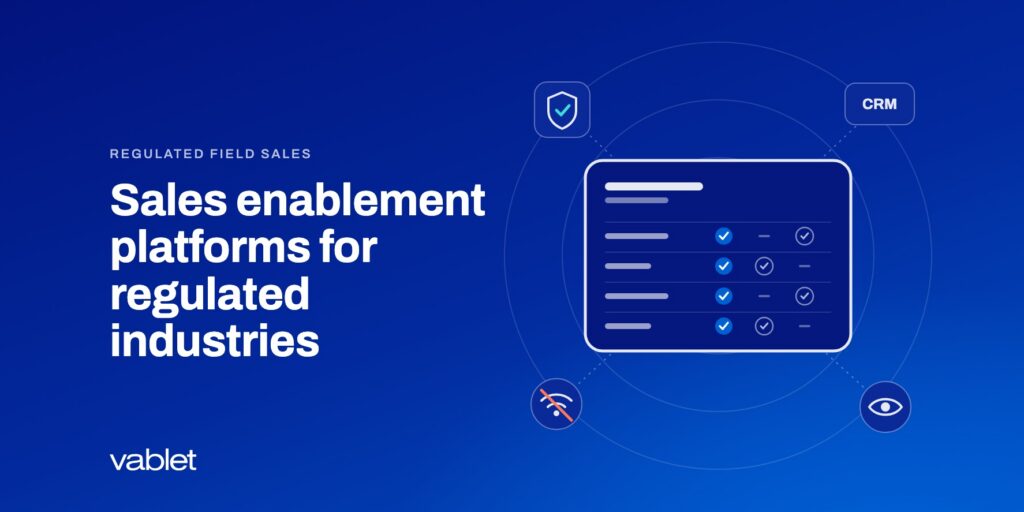
The best sales enablement platform for a regulated industry is the one that keeps only approved content in front of customers, records what was actually presented, and writes that record into your CRM, even when the meeting happens with no signal. For pharma, medical device, manufacturing and financial services teams, that usually narrows a long vendor list to a handful of platforms built for field selling.
This is not a general “top 20 sales tools” list. Sales engagement, dialers and conversation-intelligence tools solve different problems and are left out. It is also not a life-sciences-only guide; if that is your world, start with our buyer’s guide for life sciences. This post covers regulated field teams across industries, with a hard look at two things buyers tend to check too late: CRM integration and presentation analytics.
What makes a sales enablement platform fit a regulated industry?
Every sales enablement platform stores content and lets reps share it. A platform fits regulated selling when it can prove four more things.
- Only approved content reaches the field. Approval windows, expiry dates and remote removal are set centrally, and they still apply when the device is offline.
- The record shows what the customer saw. It lists which pages were presented, for how long, and what was sent afterwards. “Rep downloaded the deck” is not enough.
- That record lands in the CRM. Compliance and sales ops both work from the CRM. Activity that lives only in the enablement tool is activity nobody audits.
- It all works where reps actually sell. Hospitals, plants, job sites and secure facilities often have weak or no connectivity. A tool that needs a live connection to open a file fails in exactly those rooms.
Security paperwork matters too. Ask every vendor for its SOC 2 report, ISO 27001 certificate scope, and how it handles GDPR and, where relevant, HIPAA. Then hand those documents to your compliance team rather than taking the sales slide at its word.
Why CRM integration is where regulated deals stall
Most platforms list a Salesforce integration. The question is what it actually does. In regulated selling, three details decide whether the integration helps or just exists.
Does presented content get written to the CRM record?
A logged meeting with no content attached tells compliance nothing. You want the CRM activity to show which approved materials were presented to that contact, so the audit trail and the pipeline live in the same place.
Does it work offline?
If the rep has to wait for a signal to log the visit, the visit often never gets logged. Look for offline CRM updates that sync when the device reconnects.
Does it work on the devices reps carry?
Plenty of manufacturing and financial services reps sell from Windows laptops, not iPads. Check that CRM logging works on every device in your fleet, including the ones that never appear in a demo.
Why presentation analytics matter more in regulated industries
In most industries, presentation analytics answer a marketing question: which content works? In regulated industries they also answer a compliance question: what exactly did this customer see?
That second question needs page-level detail. Download counts and “content views” are not enough. Ask each vendor to show you, for one meeting, the pages presented, time on each page, the version of the file, and whether the record survived a meeting held offline. Our guide to sales presentation and meeting analytics lists the specific data points worth asking for.
The platforms regulated teams shortlist most often
The descriptions below are based on each vendor’s own public website as of October 2026. Capabilities vary by edition, so confirm anything that matters to you in a pilot.
1. vablet
vablet is a mobile-first sales enablement platform built for regulated field teams in life sciences, medical device and manufacturing. Reps present downloaded, approved content with no connection on iPad, iPhone, Android and Windows. Approval windows and expiry apply on the device, so out-of-date files are removed even offline.
On CRM, vablet has a native Salesforce integration: reps tap to start and end a meeting, and the content they presented is written to Salesforce. Contacts, leads, opportunities, events and custom objects can be updated offline, including on Windows. SAP C4C is supported through an integration partner. Analytics are page-level, include time per page and unused content, and can be pushed to Power BI and Tableau.
Best for: field teams in regulated industries that present in person, often without a reliable signal, and want published per-seat pricing ($25 per user per month MSRP, no implementation fee; Salesforce is a premium option).
2. Veeva Vault CRM
Veeva describes Vault CRM as a CRM for life sciences that connects sales, marketing and medical teams on one platform, with embedded AI. Veeva states that Vault CRM runs in the browser and a desktop application, with full offline support on iPad and iPhone.
Best for: pharma and biotech organizations that have standardized on the Veeva stack and want content and CRM from one vendor. It is built specifically for life sciences, so manufacturing or financial services teams will generally look elsewhere.
3. Seismic (now combined with Highspot)
Seismic positions itself as an AI-powered enablement, training and coaching platform for sales and marketing teams, and Seismic completed its merger with Highspot on August 18, 2026. Seismic lists a Salesforce integration focused on personalization and AI-powered recommendations inside Salesforce.
Best for: large enterprises running broad content, training and coaching programs, mostly for connected sellers. If you are evaluating either Seismic or Highspot, ask how the combination affects your edition’s roadmap and pricing, and test offline behavior on your own devices.
4. Showpad
Showpad describes its platform as AI-powered sales enablement designed for field sales, with sales readiness, content management, buyer engagement and analytics modules. It lists Salesforce among its integrations.
Best for: organizations that want content and readiness (training and coaching) from one suite. As with any vendor, verify offline behavior and CRM logging on each device type in your fleet during the pilot.
5. Mediafly
Mediafly says it gives field reps, dealers and distributors approved content online or offline, with a focus on manufacturers and CPG brands, and that value selling tools are built in.
Best for: manufacturers and distributor networks that sell on quantified value and want ROI and value-selling tools alongside content.
Quick comparison
| Platform | Design center (per vendor) | CRM | Offline (per vendor) |
|---|---|---|---|
| vablet | Regulated field teams: life sciences, med device, manufacturing | Native Salesforce, offline incl. Windows; SAP C4C via partner | iPad, iPhone, Android, Windows |
| Veeva Vault CRM | Life sciences CRM with sales, marketing and medical on one platform | Is the CRM | Full offline on iPad and iPhone |
| Seismic + Highspot | Enterprise enablement, training and coaching | Salesforce integration | Confirm in pilot |
| Showpad | Enablement and readiness for field sales | Salesforce integration | Confirm in pilot |
| Mediafly | Manufacturing, CPG, dealers and distributors; value selling | Confirm in pilot | Online or offline |
“Confirm in pilot” means the vendor’s public pages we reviewed did not state it clearly, not that the capability is missing.
How to run a fair two-week evaluation
- Write down your three non-negotiables. For most regulated teams: offline presenting, approved-content controls, and CRM write-back.
- Load the same three files into every platform. One large deck, one video, one interactive asset.
- Present with the network off. On every device type your reps carry, including Windows laptops if you have them.
- Expire a file and reconnect. Check that the old version disappears from every device.
- Open the CRM record. Can you see which content was presented to that contact, and when?
- Pull the analytics for one meeting. Pages, time per page, file version. If the vendor needs a week to produce it, that is your answer.
- Price the whole thing. Seats, implementation, CRM connector, and the cost of the rep hours spent learning it.
Where vablet fits, and where it doesn’t
vablet fits teams that sell in person, in places where connectivity is unreliable, under rules that make an outdated slide a compliance problem. It is SOC 2 attested, ISO 27001 certified, GDPR compliant and supports HIPAA requirements; see our security and compliance page for details. Training and onboarding are built in through an integrated LMS.
vablet is not a conversation-intelligence or call-coaching suite, and it is not a sales engagement tool for sequencing email. If your reps sell entirely over video calls, a connected-first platform may suit you better. If your organization has standardized on the Veeva stack end to end, Veeva’s own tools are the natural first look. vablet can run alongside Veeva, but its Veeva Vault PromoMats connector is still in development.
Frequently asked questions
What is the best sales enablement platform for regulated industries?
The best sales enablement platform for a regulated industry is one that enforces approved content centrally, records which pages each customer was shown, writes that activity to the CRM, and keeps working offline. Platforms regulated teams commonly shortlist include vablet, Veeva Vault CRM, Seismic, Showpad and Mediafly, each with a different design center.
Which sales enablement platforms integrate with Salesforce?
vablet, Seismic and Showpad all list Salesforce integrations on their websites. The integrations differ in what they write back. vablet records which approved content was presented in a meeting and writes that activity to Salesforce, including offline and on Windows devices.
Why do regulated industries need page-level presentation analytics?
Regulated industries need page-level presentation analytics because compliance teams must be able to show exactly what a customer was shown. A download record does not prove that. Page-level records also show marketing which slides do the work and which content goes unused.
Can a sales enablement platform work offline in hospitals and plants?
Yes, if content is downloaded to the device in advance and the platform captures activity locally. vablet lets reps present approved content with no connection on iPad, iPhone, Android and Windows, and syncs analytics and CRM activity when the device reconnects.
Is Veeva the only option for pharma sales enablement?
No. Veeva Vault CRM is a common choice for pharma companies standardized on the Veeva stack, but many life sciences teams use other platforms, such as vablet, Seismic or Showpad, particularly when they run Salesforce as their CRM or need Windows and Android support.
How much does sales enablement software for regulated teams cost?
Pricing varies widely and many enterprise vendors do not publish it. vablet publishes a list price of $25 per user per month MSRP with no implementation fee; its Salesforce integration is a premium option.
Pick the platform that survives the basement conference room
Feature lists converge. What separates platforms in regulated selling is what happens in the room with no signal, and whether the record of that meeting makes it back to the CRM. Test that first.
See vablet present your content with the Wi-Fi off, and the record it leaves in Salesforce.

vablet team
More from the vablet blog.
Preparing for 2027
A fourth-quarter planning checklist for field sales and enablement leaders: one governed library, offline on every device, CRM records that show what customers saw,…
Paul Pacun
How to choose sales enablement software for small and mid-market field teams
A practical guide for small and mid-market field sales teams choosing sales enablement software, with a 10-point demo checklist covering Windows, mobile, offline and…
Paul Pacun
How to equip reps to sell, not just pitch
Life sciences reps get minutes with customers. Here is how to equip them to sell, not just pitch: approved content, any device, tracked follow-up,…
Paul PacunGet new posts by email
Field enablement, offline content, and compliance, written for the people who run it. No pitches.
Twenty minutes. Your content. Offline.
Bring one approved deck; we present it with the Wi-Fi off and show the record it leaves behind.
Live in weeks. No implementation fee. $25 per user per month, MSRP.